Understanding the Vascular Blockage
The retina relies on a sophisticated "plumbing" system: arteries deliver oxygen-rich blood, while veins carry deoxygenated blood away. Retinal Vein Occlusion (RVO) occurs when one of these veins becomes blocked or compressed.
Imagine a drain in your home becoming clogged while the faucet is still running. The pressure builds up until the pipes leak or burst. In the eye, this results in blood and fluid spilling directly into the retinal layers. This causes sudden, painless vision loss. Depending on where the clog occurs, it is classified as either a Central Retinal Vein Occlusion (CRVO), affecting the entire retina, or a Branch Retinal Veinal Occlusion (BRVO), affecting only a specific segment.
Clinical Indicators of RVO
Unlike many eye conditions, RVO is almost always sudden and involves only one eye. Seek evaluation if you notice:
- • Sudden, painless blurring of vision in one eye.
- • A dark shadow or "grayness" over part or all of your sight.
- • Significant distortion (straight lines appearing wavy).
- • Sudden onset of "floaters" or dark spots.
The Diagnostic & Treatment Protocol
RVO management focuses on two goals: reducing the swelling in the macula (macular edema) and preventing the growth of dangerous new blood vessels (neovascularization).
1. Advanced Diagnostic Imaging
We use Optical Coherence Tomography (OCT) to measure the exact thickness of the macula and detect fluid pockets. Additionally, Fundus Fluorescein Angiography (FFA) is often performed to map the blood flow and identify areas of the retina that are "ischemic" (starved for oxygen), which helps predict the risk of future complications.
2. Intravitreal Anti-VEGF Injections
The primary treatment for the vision-robbing swelling associated with RVO is Anti-VEGF therapy. These medications (like Lucentis or Eylea) are injected into the eye to block the chemical signal that causes vessels to leak. By "drying up" the macula, vision often improves significantly. Most patients require a series of monthly injections initially, followed by a maintenance schedule as the eye stabilizes.
3. Retinal Laser Photocoagulation
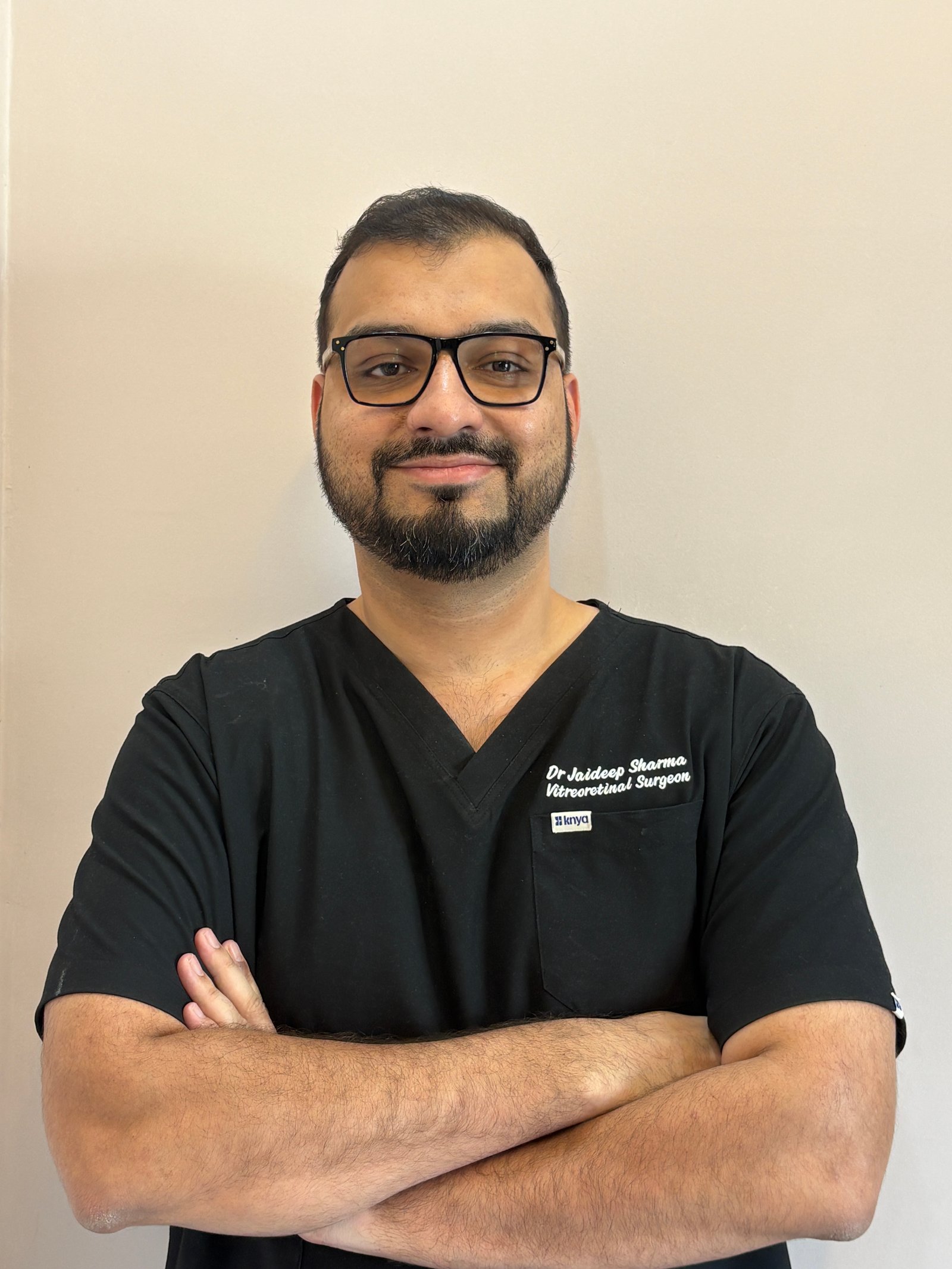
If the blockage has caused large areas of the retina to lose their blood supply, the eye may try to grow abnormal new vessels in response. These vessels are fragile and can lead to severe bleeding or glaucoma. In these cases, Dr. Jaideep Sharma utilizes targeted Laser Photocoagulation to treat the oxygen-starved tissue, permanently stopping the growth of these dangerous vessels.
4. Managing Systemic Risk Factors
Because RVO is a vascular event, it is often a "wake-up call" for your overall health. We work closely with your physician to ensure that underlying conditions like hypertension, high cholesterol, and diabetes are aggressively managed to prevent a recurrence in the other eye or more serious systemic events.
Prognosis & Visual Recovery
Visual recovery after an RVO varies from patient to patient. While some regain near-normal vision with timely injections, others may have permanent blind spots if the retina was deprived of oxygen for too long. The single most important factor in a successful outcome is the speed of intervention. Early treatment of macular edema before permanent structural changes occur is the key to reclaiming your sight.