Understanding ARMD
Age-Related Macular Degeneration (ARMD) is the leading cause of vision loss in people over the age of 50. It specifically targets the macula, the small central portion of the retina responsible for the sharp, detailed vision needed for tasks like reading, driving, and recognizing faces.
ARMD does not cause total blindness, as peripheral (side) vision remains intact. However, the loss of central vision can be profound. The disease progresses in two primary forms: the more common "Dry" form and the more aggressive "Wet" form. Understanding which type you have is critical for determining the appropriate clinical intervention.
Dry vs. Wet ARMD: The Clinical Difference
-
Dry ARMD (Non-Exudative)
Characterized by the gradual thinning of macular tissues and the accumulation of Drusen (yellow deposits). It progresses slowly over years and is managed through nutritional therapy (AREDS2) and lifestyle changes.
-
Wet ARMD (Exudative)
A more advanced stage where abnormal, fragile blood vessels grow under the macula. These vessels leak fluid or blood, causing rapid distortion and sudden vision loss. This is a medical emergency requiring immediate injections.
The Diagnostic & Treatment Protocol
At Prasan Nethralaya, we utilize high-definition imaging to monitor the health of your macula down to the cellular level. Early detection is the only way to prevent irreversible scarring.
1. High-Definition OCT Imaging
The Optical Coherence Tomography (OCT) is our primary tool for managing ARMD. This non-invasive scan provides cross-sectional images of the retina, allowing us to see Drusen in Dry ARMD and detect even microscopic amounts of fluid leakage in Wet ARMD. Regular OCT scans are mandatory for patients receiving injections to track their response to treatment.
2. Anti-VEGF Injection Therapy
For Wet ARMD, the standard of care is Anti-VEGF therapy. Medications such as Accentrix, Razumab, or Eylea are injected into the eye to block the "Vascular Endothelial Growth Factor" protein that causes abnormal vessel growth. These injections stop the leakage, shrink the abnormal vessels, and in many cases, can significantly improve visual clarity. The procedure is performed under strict sterile conditions and is virtually painless.
3. Home Monitoring: The Amsler Grid
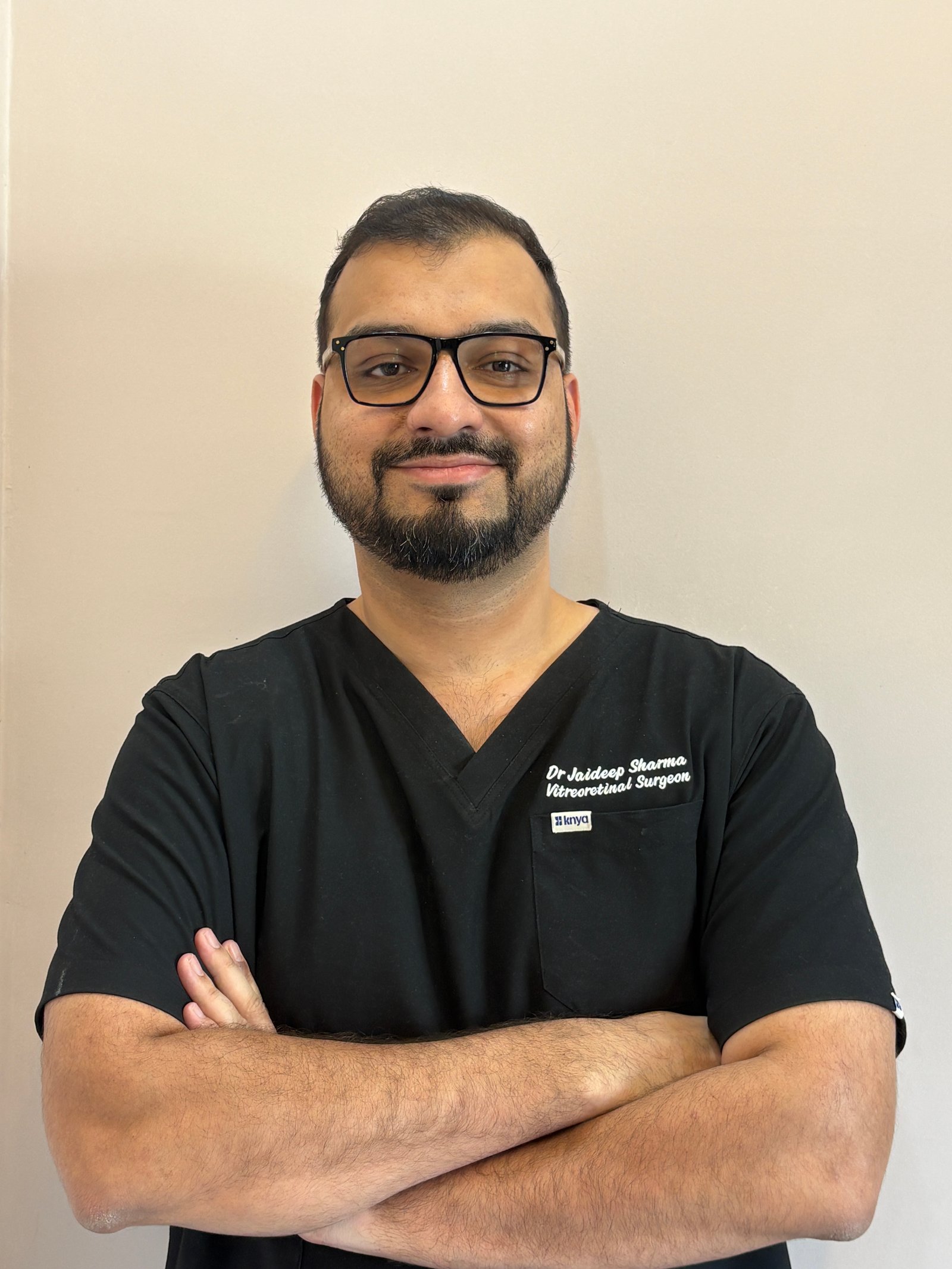
Because ARMD can change from Dry to Wet between clinical visits, we provide all our patients with an Amsler Grid. By checking the grid daily with one eye at a time, patients can detect Metamorphopsia (distortion). If the straight lines of the grid appear wavy, curved, or broken, it is a sign of active fluid leakage, and the patient must contact Dr. Jaideep Sharma immediately.
Lifestyle & Nutritional Support
For patients with Dry ARMD, clinical studies (AREDS and AREDS2) have shown that a specific combination of high-dose antioxidants—including Lutein, Zeaxanthin, Vitamin C, Vitamin E, and Zinc—can reduce the risk of progressing to the advanced Wet stage by approximately 25%. Additionally, stopping smoking is the single most important lifestyle change a patient can make, as smokers are four times more likely to develop advanced ARMD.