Understanding Pediatric Eye Cancer
Retinoblastoma is a rare but highly aggressive form of cancer that rapidly develops from the immature cells of the retina (the light-detecting tissue at the back of the eye). It is the most common primary eye cancer in children, typically diagnosed before the age of 5.
Because the eye is directly connected to the brain via the optic nerve, an untreated retinoblastoma tumor will inevitably travel up the nerve, spreading the cancer to the brain and the rest of the body. Early detection is the absolute key to survival. When caught in its early stages, before it has spread outside the eye, retinoblastoma has a survival rate exceeding 95% in specialized centers.
The Early Warning Signs
Babies cannot tell you their vision is failing. Parents are almost always the first to notice the signs. Seek an urgent pediatric oncology evaluation if you observe:
- • Leukocoria (The White Glow): Instead of the normal "red eye" seen in flash photography, the pupil reflects a bright white or yellow glow. This is the tumor reflecting the flash.
- • Strabismus (Crossed Eyes): One eye begins to turn inward or outward because it has lost vision and can no longer focus properly alongside the good eye.
- • Redness and Swelling: A persistently red, swollen, or inflamed eye that does not respond to standard infection treatments.
The Diagnostic Protocol (EUA)
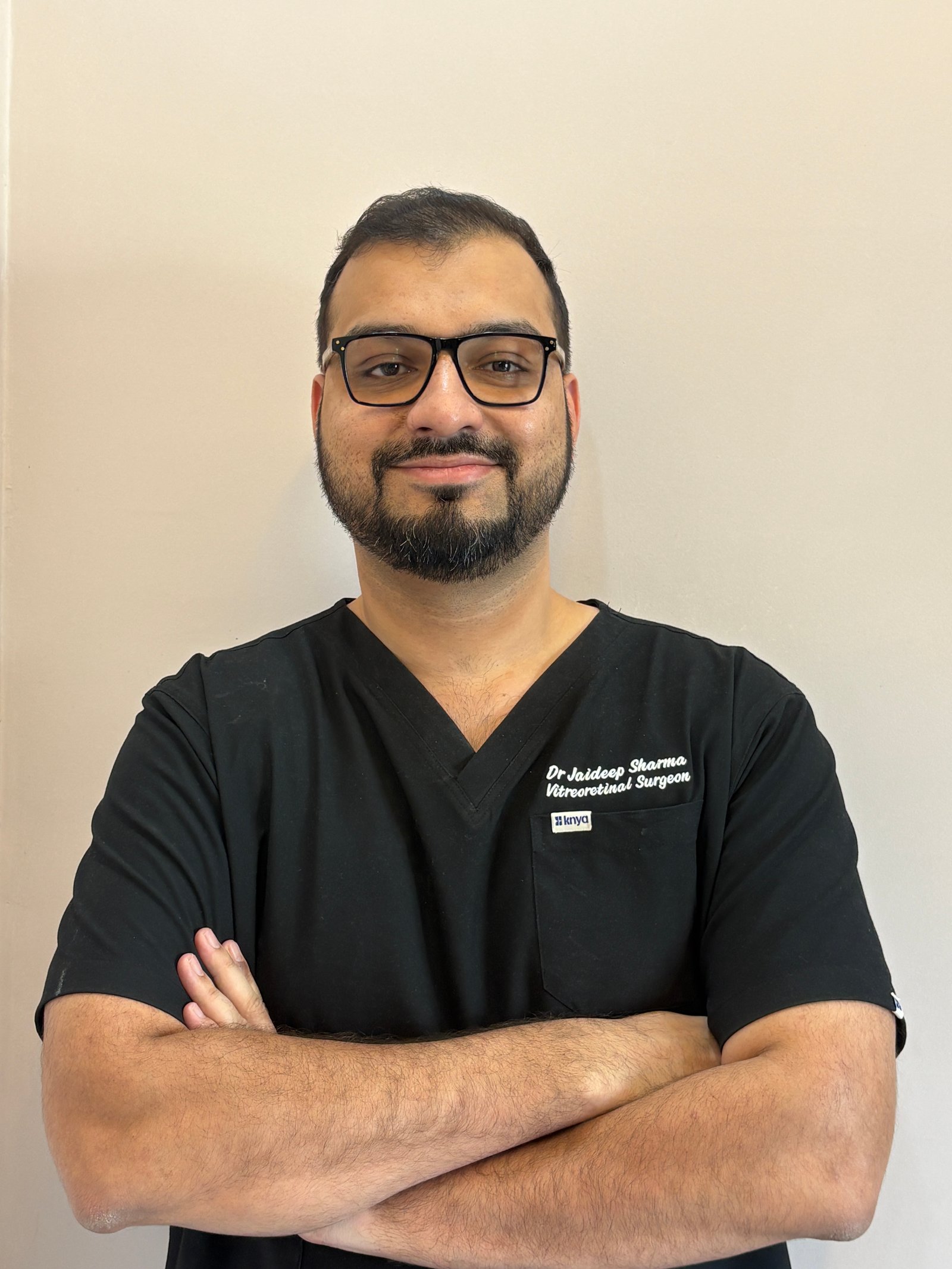
Diagnosing eye cancer in an infant requires specialized protocols. Dr. Jaideep Sharma performs an Examination Under Anesthesia (EUA). While the child is safely asleep, the pupils are fully dilated, and advanced imaging systems (like a RetCam) are used to map the exact size, location, and number of tumors in the retina. Depending on the findings, MRI or ultrasound imaging may be ordered to ensure the cancer has not reached the optic nerve.
Multi-Tiered Oncology Interventions
The treatment of Retinoblastoma is a tiered priority system: First, save the child's life. Second, save the physical eye. Third, preserve whatever functional vision remains. Treatment protocols are highly customized based on the tumor's staging.
1. Focal Laser Therapy (TTT) and Cryotherapy
If the tumor is caught very early and is incredibly small, it can often be destroyed without chemotherapy. Dr. Jaideep uses Transpupillary Thermotherapy (TTT)—an infrared laser that heats the tumor cells until they die—or Cryotherapy, which freezes the cancer cells. These treatments are often used to "mop up" small tumors after chemotherapy has shrunk the main mass.
2. Advanced Chemotherapy (Systemic & Intra-Arterial)
For larger tumors, chemotherapy is required. While traditional IV (Systemic) chemotherapy is still used, modern ocular oncology leans heavily on Intra-Arterial Chemotherapy (IAC). In this revolutionary procedure, a micro-catheter is threaded through the body directly into the ophthalmic artery supplying the eye. A massive, concentrated dose of cancer-killing drugs is delivered directly to the tumor. This often saves eyes that would previously have required surgical removal, while drastically reducing the side effects of full-body chemo.
3. Enucleation (Life-Saving Surgery)
If the tumor is massive, has destroyed all vision in the eye, or shows signs of invading the optic nerve, attempting to save the eye risks the child's life. In these severe cases, the safest and only definitive treatment is Enucleation (the complete surgical removal of the eye). During the same surgery, an orbital implant is placed deep in the socket. Once healed, an ocularist will craft a highly realistic, custom-painted prosthetic eye that moves naturally, ensuring the child retains excellent cosmetic symmetry as they grow.