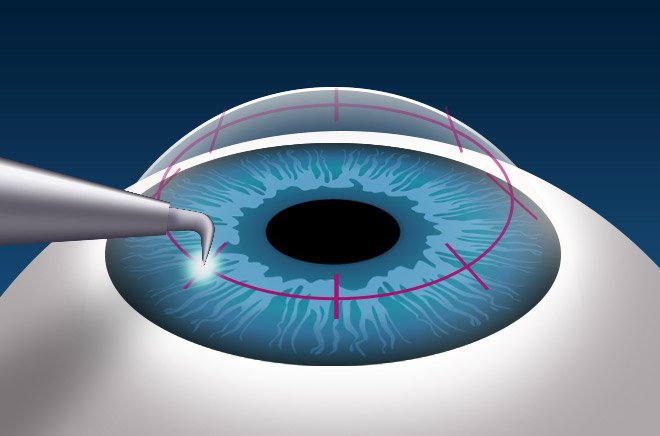
Understanding Keratoplasty
The cornea is the eye's clear, protective outer layer. When it becomes scarred, swollen, or distorted due to disease or injury, light cannot reach the retina clearly, leading to severe visual impairment. A Cornea Transplant, or Keratoplasty, is a surgical procedure that replaces a portion of your damaged cornea with healthy corneal tissue from a donor.
Unlike traditional organ transplants, the cornea is "immune-privileged," meaning it does not require blood-type matching, and the risk of rejection is significantly lower. Modern advancements have allowed us to move away from "one-size-fits-all" surgery. Today, we perform Lamellar Keratoplasty, where we surgically "peel" and replace only the specific diseased layers, leaving your healthy tissue intact.
Who Needs a Transplant?
A transplant is typically recommended when other treatments can no longer provide functional vision. Clinical indicators include:
- • Advanced Keratoconus with severe thinning or scarring.
- • Fuchs' Dystrophy causing chronic corneal swelling.
- • Corneal scarring from infections (like Herpes) or injuries.
- • Bullous Keratopathy (swelling after cataract surgery).
Advanced Surgical Techniques
At Prasan Nethralaya, Dr. Neelam Sharma customizes the transplant approach based on the specific layer of corneal damage. This "layered" approach is the global benchmark for superior safety.
1. Penetrating Keratoplasty (PK)
This is the traditional "full-thickness" transplant. The entire central portion of the damaged cornea is removed using a precision trephine and replaced with a healthy donor cornea. The new cornea is secured with microscopic sutures. This is used when all layers of the cornea are permanently damaged.
2. DALK (Deep Anterior Lamellar Keratoplasty)
The "partial-thickness" breakthrough for Keratoconus. In DALK, we replace only the front and middle layers of the cornea (the epithelium and stroma), leaving the patient's own healthy back layer (the endothelium) untouched. This virtually eliminates the risk of endothelial rejection—the most common cause of transplant failure.
3. DSAEK & DMEK (Endothelial Keratoplasty)
The "keyhole" transplant. If only the back layer of the cornea is failing (common in Fuchs' Dystrophy), we perform DSAEK or DMEK. Instead of a large incision, we insert a microscopic layer of donor cells through a tiny opening. This procedure requires no surface stitches and offers the fastest visual recovery in all of keratoplasty.
The Road to Visual Recovery
Keratoplasty recovery is a marathon, not a sprint. While the surgery itself is a day-care procedure performed under local anesthesia, achieving your final visual acuity requires patience. You will be prescribed a strict regimen of steroid eye drops for several months to prevent rejection. Micro-sutures used in PK and DALK are typically left in place for 6 to 12 months to ensure the new cornea is perfectly integrated before being painlessly removed.
It is vital to wear a protective eye shield while sleeping and avoid any activities that could result in a direct blow to the eye. Most patients eventually achieve excellent vision, often with the help of glasses or specialized contact lenses to fine-tune the final optical result.